Steve Wynn and The Mirage Las Vegas History: How One Casino Changed Everything
On November 22, 1989, a volcano erupted on Las Vegas Boulevard.
Not a real one. But to the crowds who had never seen anything like it, the distinction hardly mattered. The Mirage had just opened, and for the first time in the city's history, people weren't coming to gamble. They were coming to see something.
That shift — from gambling destination to destination resort — is The Mirage Las Vegas history in a single sentence. And with the Neon Museum hosting a conversation with Steve Wynn on October 22 about the property's legacy, there's no better time to talk about what that opening actually meant.
For those of us who have lived and worked in Las Vegas for decades, this isn't trivia. It's the story of how our city became our city.
What the Strip Looked Like Before The Mirage
By the late 1980s, the Strip was tired. The Flamingo, the Sands, the Desert Inn — these were storied names, but the properties themselves were aging, and the broader gambling industry was facing real competition from Atlantic City, which had legalized casino gambling in 1976. Las Vegas wasn't growing. It was holding on.
The city's identity was built almost entirely around low-cost gambling packages. Cheap buffets, deep-discount rooms, and loose slots designed to keep people at the tables. If you weren't there to gamble, there wasn't much reason to come.
Steve Wynn looked at that model and decided to build something it had never seen before.
What The Mirage Actually Built
The Mirage cost $630 million to construct, which made it the most expensive hotel ever built at the time. Wynn financed it through junk bonds, a move that shocked the industry and required the property to generate roughly $1 million per day just to break even. Most observers thought he had lost his mind.
What opened on that November night was something closer to a theme park crossed with a luxury resort. The erupting volcano out front ran on a schedule. Inside, a 20,000-gallon aquarium sat behind the registration desk. Siegfried and Roy performed with white tigers in a purpose-built showroom. The pool complex was the largest on the Strip. The rooms were bigger and nicer than anything competitors were offering.
And critically, The Mirage was profitable within weeks. It hit that $1 million daily threshold and kept going.
The industry paid attention. Within a few years, MGM Grand, Luxor, Treasure Island, and New York-New York all broke ground. Each one tried to out-spectacle the last. The megaresort era had started, and The Mirage Las Vegas history is where it begins.
Why It Still Shapes the Las Vegas We Live In
The ripple effects of that 1989 opening reach into corners of the city that have nothing to do with gambling.
The construction boom The Mirage triggered created demand for workers, and workers needed homes. The residential growth that followed through the 1990s pushed development outward from the Strip into what are now established neighborhoods across the valley. Infrastructure expanded. Schools were built. The city's population, roughly 740,000 in the metro area in 1990, climbed toward 1.4 million by 2000, according to U.S. Census data.
The entertainment model Wynn introduced also diversified the local economy in ways that matter for residents today. A city built purely on gambling is fragile. A city built on hospitality, entertainment, food, and conventions is harder to break. We saw that fragility tested during the 2008 recession and again during the pandemic closures of 2020. But the diversification The Mirage helped create gave the economy more ways to recover.
The Mirage closed in July 2024. Hard Rock International acquired the property and plans to demolish it and build a guitar-shaped hotel tower, similar to the one at their Hollywood, Florida location. Construction timelines are still in flux.
For people who grew up here, or who moved here during the boom years, watching that building come down will feel like something. The Neon Museum conversation with Wynn on October 22 is worth attending if you want to hear the story directly from the person who started it. Events like that one connect residents to the history they're actually living inside.
If you want to read more about what makes this city worth knowing deeply, browse our blog for more local history and neighborhood coverage.
Frequently Asked Questions
When did The Mirage open and who built it?
The Mirage opened on November 22, 1989, and was developed by Steve Wynn under his company Mirage Resorts. It cost approximately $630 million to build, making it the most expensive hotel construction project completed at that time.
Why is The Mirage considered so important to Las Vegas history?
The Mirage Las Vegas history matters because it introduced the megaresort model to the Strip, shifting the city's identity from a low-budget gambling destination to a world-class resort corridor. That shift directly triggered a construction boom through the 1990s that reshaped the entire valley, including residential growth across the metro area.
What is happening to The Mirage now?
The Mirage closed in July 2024 after Hard Rock International purchased the property from MGM Resorts. Hard Rock plans to demolish the existing structure and build a new guitar-shaped hotel tower on the site, though the full construction timeline has not been finalized as of this writing.
Related reading
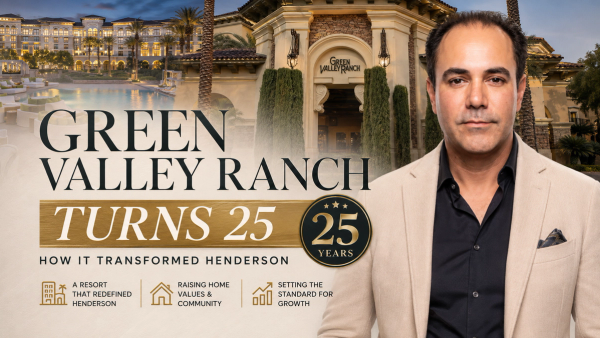
• Green Valley Ranch Turns 25 This December — A Look Back at How It Transformed Henderson
Steve Wynn and The Mirage Las Vegas History: How One Casino Changed Everything — in under a minute
Homes for Sale
.webp)
Ready to Find Your
Next Home?
The Crighton Rinaldi Team specializes in luxury real estate across Las Vegas and Henderson. Let’s find the right home, and neighborhood, for you.
← All Blog Posts